The Brain Behind the Behaviour


Most leadership coaching addresses what leaders do. We address what drives it: the neuroscience of why protection patterns form, and how to rewire them.

We are not here to add more to what is already working. We are here to understand what is getting in the way, and why the same patterns keep returning no matter how much work we do on the surface.


The New Leadership Problem

Neuro-Rigidity is what happens when protection becomes the operating system

In complex environments, we do not struggle because we lack intelligence, drive, or capability. We struggle when the nervous system keeps using old protective strategies in new conditions.

It shows up as over-control, people-pleasing, over-preparation, avoidance, comparison, perfectionism, and the quiet exhaustion of constantly proving we belong. The work is not to push harder. The work is to increase adaptive capacity.

The Full Architecture

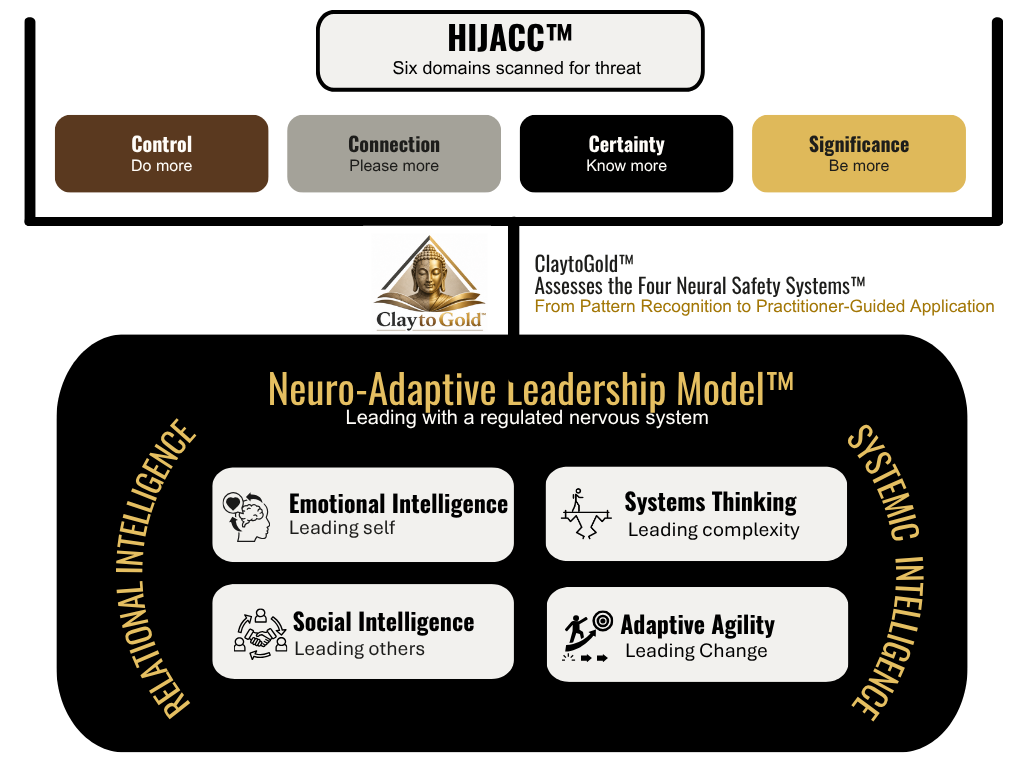
The Neuro-Adaptive
Leadership Model™

ClaytoGold™ is the foundation. But sustained leadership effectiveness at the top requires more.

The Neuro-Adaptive Leadership Model™ integrates four interdependent pillars that help leaders stay grounded, relational, strategic, and adaptive under pressure.

The Inner Work of
Emotional Intelligence (EQ)

Navigate pressure, regulate emotions, and lead with clarity through complexity. 

Apply neuroscience-informed strategies to:

  • Stay composed under pressure and uncertainty
  • Strengthen self-awareness and navigate triggers
  • Improve judgment by aligning emotion with logic
  • Build resilience to rebound from challenges with purpose

The Outer Work of
Social Intelligence (SQ)

Build authentic influence, communicate powerfully, and strengthen trust across teams.

Grow your interpersonal effectiveness to:

  • Communicate with clarity, empathy, and precision
  • Manage conflict and foster collaboration
  • Build inclusive, high-performing cultures
  • Influence outcomes by understanding people deeply

COMPLEX PROBLEM SOLVING:
Systems Thinking

Strategic leadership starts with how you think.

Learn to:

  • Navigate fast/slow thinking and respond with intention
  • Use a whole-brain approach, integrating logic, intuition, and insight
  • Apply frameworks like DSRP theory to solve complex problems—zoom out to see the big picture and zoom in to act with clarity
  • Think bigger, act smarter, and lead more strategically

The leadership edge:
Adaptive Agility

Grounded in the ACCEL™ Model 

You’ll build confidence to:

  • Lead through uncertainty with composure and purpose
  • Leverage digital tools strategically to amplify innovation and collaboration
  • Make data-informed decisions grounded in emotional and social awareness
  • Navigate hybrid, remote and evolving environments with resilience and focus

The Foundation

How the Brain Scans for Safety

Your nervous system is constantly scanning six domains for social threat. This is the HIJACC™ Framework, the foundation of everything we do.

Hierarchy: Status, rank, power dynamics, and how your role is perceived in relation to others.

Individual Experience: Identity, neurodivergence, lived experience, values, culture, and your physical and emotional state in the moment.

Justice: Fairness, equity, consistency, and whether the rules are applied evenly.

Autonomy: Choice, control, and influence over decisions that affect you.

Certainty: Clarity, predictability, and whether expectations are clear.

Connection: Belonging, inclusion, relational safety, and whether it is safe to be fully yourself.

When one or more of these domains feels under threat, your nervous system activates a protective response. That response is fast, automatic, and almost always mistaken for a confidence problem.

The Problem Already Known

It Shows Up the Same Way. Every Time. 

You have seen it. In the boardroom or in the coaching room, the pattern is remarkably consistent. High-performing people who look completely capable on the surface but privately question whether they belong. They overprepare. They second-guess decisions they have made a hundred times before. They minimise wins and immediately move the goalpost. They work twice as hard as everyone else just to keep up.

Most of them do not call it imposter syndrome. High achievers rarely do.

They say things like:

“I've been incredibly lucky.”

“I'm just detail-oriented.”

“I have to work twice as hard as everyone else to keep up.”

What they mean is:

“I'm waiting for the moment someone figures it out.”

The traditional response is confidence-building. Positive reframes. Credential-chasing. The work lands, briefly. Then the pattern returns.

Because the real problem is not what they think. It is how the nervous system perceives threat.

The Reframe

Imposter Syndrome is not a confidence problem

Imposter syndrome is Executive Cognitive Dissonance:

the gap between what a leader knows to be true about their capability and what they feel in the moment of doubt.

Self-doubt is not proof of a problem. It is proof that a leader is operating at the edge of their comfort zone. Which is exactly where leaders are supposed to be.

The issue is not the doubt. The issue is that the protective pattern running underneath it treats growth and visibility the same way it treats threat.

And no amount of positive affirmation changes what the nervous system is actually protecting against.

What if the problem was not your thinking, but your nervous system's outdated threat assessment?

The Four Neural Safety Systems™

How Protection Shows Up in Leadership

Control
Do more

When uncertainty rises, they tighten their grip. Perfectionism, micromanagement, over-functioning, inability to delegate. The system is protecting against a world that feels unpredictable.

Core fear:
If I let go, something will collapse and I will be blamed.

Connection
Please more

When belonging feels at risk, they work to preserve it. People-pleasing, conflict avoidance, over-apologising, shape-shifting to fit the room. The system is protecting against rejection.

Core fear:
If I am fully myself, I will be excluded.

Certainty
Know more

When the stakes rise, they chase clarity. Over-preparing, analysis paralysis, staying silent, and second-guessing decisions become protective strategies. The system is protecting against exposure.

Core fear:
If I speak before I am completely ready, I will be exposed.

Significance
Be more

When value feels conditional, they perform for proof. Overachieving, minimising wins, comparing themselves constantly, tying self-worth to external validation. The system is protecting against being ordinary.

Core fear:
If I stop proving myself, I will stop mattering.

Most high-achievers operate from one dominant system. Some operate from two. Almost all feel the pull of all four. The protective patterns are not flaws. They are the nervous system's way of managing perceived threat. But when the threat perception is outdated or mismatched to the actual situation, the protection becomes the problem.

The ClaytoGold™ Approach

From Pattern Recognition to Rewiring

ClaytoGold™ is where individual pattern recognition begins.

Most imposter syndrome assessments tell us whether the pattern is present and how severe it appears to be. That is validation. It is not strategy.

The ClaytoGold™ Imposter Syndrome Assessment identifies which of the Four Neural Safety Systems™ is running the protective pattern. It maps which of the 20 ClaytoGold™ behavioural patterns show up under pressure and builds a rewiring pathway specific to that driver.

The assessment is supported by a debrief framework and a targeted rewiring toolkit. Each system has its own set of activities, sequenced for sustainable change. We understand the biology driving the behaviour, then use concrete tools to rewire it.

The pattern becomes visible. The guesswork stops. And the work actually sticks.

The Origin Story

The Gold Was Always There

The name ClaytoGold™ comes from the story of a giant clay Buddha that sat undisturbed for centuries. When a crack formed, caretakers discovered what had always been there: solid gold beneath the surface.

The clay was not the statue. It was the protection.

Layer by layer, through unmet expectations, withheld praise, and criticism that cut too deep, we bury the very thing we are trying to protect. The cracks we fear are not exposing a fraud. They are revealing the gold.

You were never broken. Only buried.

The work is not about becoming someone new. It is about unlearning the protection that covered who you have always been.

The COLLECTIVE Architecture

When the Leader Changes, the Room Changes Too

selected

Rewiring your own protective patterns is the foundation. But leaders do not operate in isolation. Every decision, every conversation, every moment of pressure happens in relationship with other people, and those people have their own nervous systems scanning for the same threats.

ACCEL™ addresses what happens next. Once we understand the biology driving our own behaviour, we can begin to understand why change initiatives stall, why high-performing teams suddenly fragment under pressure, and why the same conflicts keep surfacing no matter how many conversations we have about them.

It is not about managing people differently. It is about understanding what their nervous systems are protecting against, and leading in a way that reduces the threat rather than amplifying it.

This is how individual rewiring becomes organisational momentum.

It is built on PERCEPTIONALITY®, the perceptual foundation that shapes what leaders notice, interpret, and respond to before collective change can occur.

Who This Serves

Built for the accomplished leader who is privately struggling

This approach is built for leaders and professionals who are already accomplished, but privately carrying more pressure than most people can see. Not because they lack capability, but because the stakes are higher, the visibility is greater, and the protection has gotten louder.

It is also built for the coaches, trainers, and consultants who work with these leaders and want to move beyond symptom management into pattern rewiring. The framework is licensed, replicable, and designed for thoughtful integration into an existing practice.

The Full Journey

Two Paths, One Rewiring Framework

The work begins with recognition. The next step depends on whether we are doing this work personally or bringing it into practice with clients.

For Leaders

Begin With Pattern Recognition

We recognise the pattern through ClaytoGold™ and identify which neural safety system is running it. From there, we begin rewiring the protective response through targeted activities and practical leadership integration.

The result is not surface-level confidence. It is sustained effectiveness under pressure, built by helping the nervous system learn that the old threat is no longer present.

This path is especially useful when the outward performance looks strong, but the internal cost has become too high.

Best next step: complete the ClaytoGold™ Imposter Syndrome Assessment and begin with a private debrief.

Begin with the Assessment

For Practitioners

Bring Precision Pattern Recognition Into Your Client Work

We license ClaytoGold™ to help coaches, trainers, and consultants bring precision pattern recognition into their existing client work.

Your clients stop spinning on symptoms and start working with the driver underneath the behaviour. You gain a teachable, replicable methodology designed for meaningful change.

This path is designed for practitioners who want a clear, structured way to move clients from insight into applied rewiring.

Best next step: explore whether ClaytoGold™ practitioner licensing is the right fit for your work.

Explore Practitioner Licensing

What Happens Next

Begin with recognition. Then choose the right path.

Whether we are doing this work personally or bringing it into practice with clients, the first step is understanding the protective pattern underneath the performance.

The work begins when we stop treating self-doubt as a flaw and start understanding it as protection that can be rewired.