REWIRING IMPOSTER SYNDROME PRACTITIONER TOOLKIT
This is your practitioner-only toolkit library. Use these downloads to support session delivery, client debriefs, and between-session assignments. You choose the tools, worksheets, and exercises that best support your client's rewiring process. The toolkit is designed to help clients decode patterns, regulate their nervous system, take aligned action, and reinforce new neural pathways that support confidence, resiliency, and authentic leadership.
This is a neuroscience-based practitioner toolkit for rewiring imposter syndrome, built to translate assessment insight into meaningful behaviour change.
This is not a checklist. Transformation does not come from handing out tools. It comes from how you apply them. Your pacing, containment, and precision are what make the work land.
Use the toolkit to support clients as they:
- interrupt protective thought loops
- regulate emotional and physiological activation
- test new behaviours that create corrective evidence
- reinforce progress so the new response holds under pressure
Outcome: deeper pattern recognition, stronger self-regulation, and more consistent response capacity.
Download resources individually when you need a specific reference, or use the Print Pack for bundled downloads.
Awareness Building Activities (Days 1–30)
Goal: strengthen pattern recognition across all four systems before you prescribe system-specific rewiring.
PHASE 1
Golden Buddha and the Three Voices is a foundational awareness intervention. Use it early to establish shared language for the client’s internal experience under pressure and to reduce “protective fear = truth.”
Coaching intent: Identify the dominant voice, label it, interrupt it, regulate the body, re-anchor to facts, and select one next action.
System-Specific Rewiring Menus (Days 30–60)
Goal: target the client’s primary Neural Safety Behaviour™ with small, repeatable behaviour experiments.
PHASE 2
CONTROL
Goal: reduce over-functioning, perfection loops, and “I have to hold it all.”
Control clients don’t need more insight, they need proof that “less” doesn’t equal “unsafe.”
CONNECTION
Goal: stop trading self-respect for approval, build tolerance for tension.
Connection clients don’t need more empathy, they need the skill of staying steady while someone else is disappointed.
CERTAINTY
Goal: stop over-preparing and delaying, learn to move with “enough” clarity.
Certainty clients don’t need “more information,” they need repeated experiences of competence without perfect readiness.
SIGNIFICANCE
Goal: stop proving, stop chasing validation, strengthen internal ownership of value.
Significance clients don’t need bigger achievements, they need to let the truth land and stop disqualifying impact.
Reinforcement Menus (Days 60–90)
Goal:consolidate the new response so it holds under pressure, prevents relapse, and becomes identity-level.
PHASE 3
RELAPSE RECOVERY PROTOCOL
IDENTITY AUTOMATION
DECISION FILTER TO STOP FEAR-BASED EFFORT
INTEGRATION AND PROOF CAPTURE
REGULATION AS A STANDARD
Self-Coaching Resource
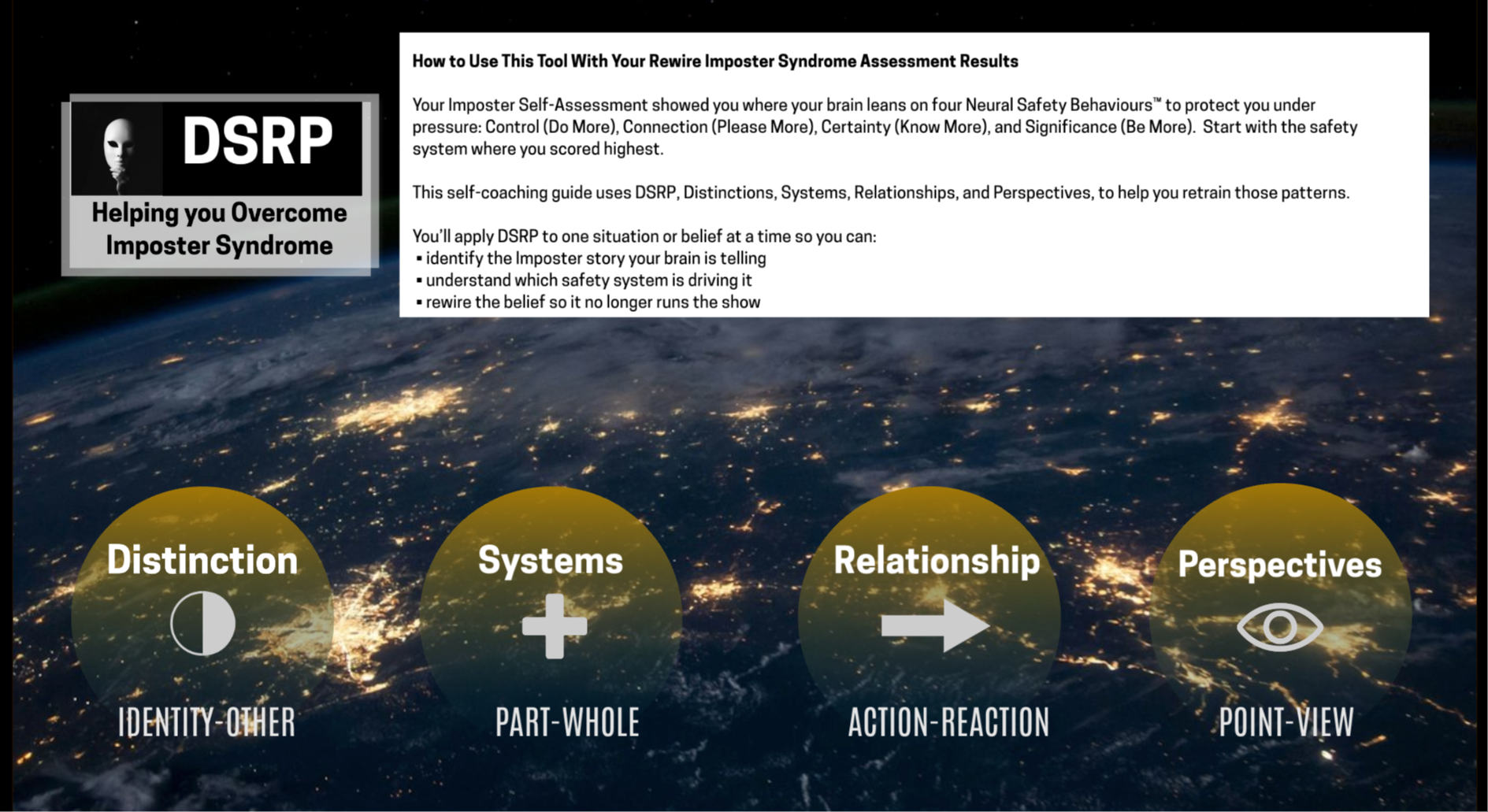
DSRP: Client Self-Coaching Map (Between session support)
Use this when you want the client to work through a triggered moment using the same prompts you’d run in session. It turns a spike into usable data for your next debrief.
What it helps your client do
-
Name the belief/story that just got activated
-
Expose the pattern underneath (assumptions, protective strategy, familiar “loop”)
-
Settle the nervous system so they can think clearly again
-
Reframe with accuracy, not forced positivity
-
Choose one aligned action that matches the leader they’re becoming
When to prescribe it
Use this as an “in-the-moment” tool when your client:
-
Spirals after feedback, a meeting, or a mistake
-
Falls into overpreparing, overperforming, perfectionism, or people-pleasing
-
Feels stuck between what they want and what fear is pushing them to do
-
Starts shrinking, delaying, or self-editing right before visibility
How to position it with your client (script)
“Between sessions, your brain will still try to protect you. That’s normal. This map gives you a way to coach yourself through the moment so you don’t make decisions from threat mode. Use it the same day something hits, even if you only complete the first half. We’ll review what you captured in our next session and build your plan from real data, not memory.”